PHP2Shell Zero-Day: 1.38M Exposed Hosts Vulnerable to Critical PHP Core RCE (CVE-2026-109618)
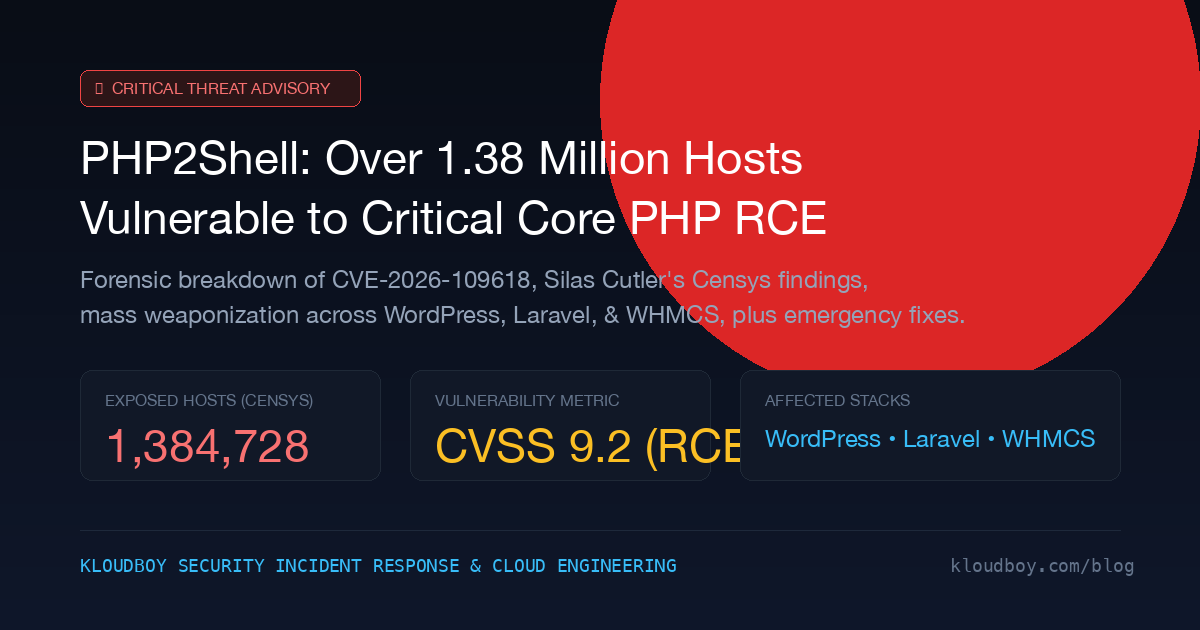
Security researcher Silas Cutler revealed over 1.38 million internet-exposed servers are vulnerable to PHP2Shell (CVE-2026-109618 & CVE-2026-109619). Here is the technical breakdown, exploit analysis, and emergency mitigation playbook.
The web infrastructure ecosystem is facing one of the most consequential security events in recent memory. On October 20, 2026, Silas Cutler—Principal Security Researcher at Censys and prominent threat intelligence analyst—published alarming findings on X (formerly Twitter):
“Rough estimate - likely over 1.3 million internet exposed hosts vulnerable to #PHP2Shell”
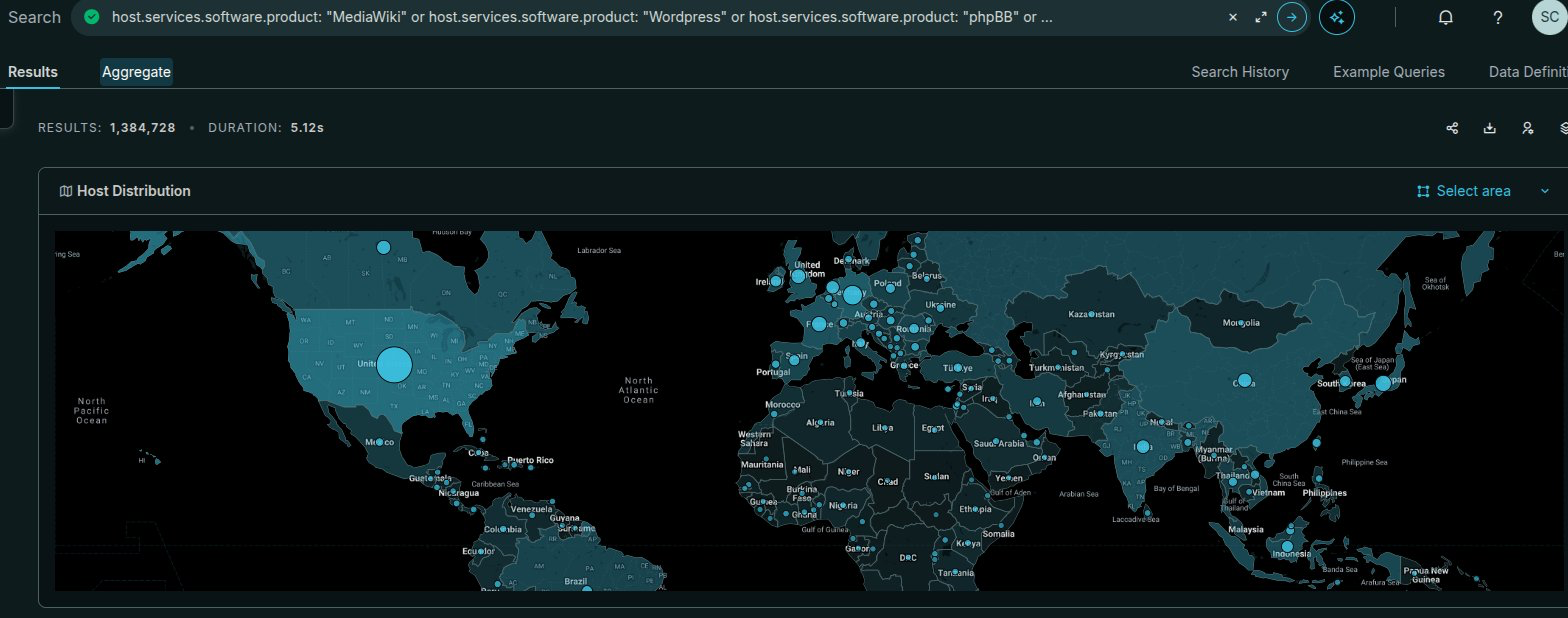
Backing this estimate is live Censys telemetry identifying 1,384,728 internet-facing hosts running affected PHP configurations, accompanied by a leaked, working exploit demonstration targeting the PHP core execution layer across virtually every dominant PHP application on the web.
The vulnerabilities—tracked as CVE-2026-109618 and CVE-2026-109619—carry an official CVSS v4.0 severity rating of 9.2 (Critical), with real-world weaponization achieving unauthenticated remote code execution (RCE) with root/web-user privileges.
Whether you manage an enterprise fleet, an e-commerce platform on Magento, a SaaS billing portal on WHMCS, or high-traffic WordPress websites, this is an all-hands emergency.
Here is the exhaustive forensic breakdown of the vulnerability, the mechanics of the leaked php2shell exploit tool, the affected technology matrix, and the immediate step-by-step remediation plan.
1. What Makes PHP2Shell Uniquely Dangerous?
Unlike typical vulnerabilities reported in the PHP ecosystem, this is not a plugin vulnerability, a theme flaw, or a CMS-level misconfiguration.
CVE-2026-109618 and CVE-2026-109619 reside inside the PHP Core runtime engine itself.
+-------------------------------------------------------------------+
|               INCOMING MALICIOUS HTTP REQUEST                     |
+-------------------------------------------------------------------+
                                  │
                                  ▼
           [ Web Server: Nginx / Apache / OpenLiteSpeed ]
                                  │
                                  ▼
         [ SAPI Boundary: mod_php / php-fpm / lsphp Engine ]
                     │
                     ├─► [ PHP CORE RUNTIME ] ◄── Exploit Triggers Here!
                     │   (CVE-2026-109618: Memory Corruption & RCE)
                     │
                     ▼
          [ Application Layer: WordPress / Laravel / Magento ]
              (BYPASSED: Never reaches application logic)
The Architectural Threat:
- Universal Applicability: Because the flaw triggers within the PHP core binary and memory management subsystem, attackers do not need to find a vulnerable plugin or bespoke application route. Calling any accessible PHP script—even a blank file or a framework bootstrap entrypoint like
index.php—is sufficient to execute the exploit. - Pre-Authentication Exploitation: The exploit operates entirely unauthenticated. No user credentials, API keys, or session tokens are required.
- Premature Public Leak: The exploit toolkit (
php2shell.py) and weaponized proofs-of-concept were leaked publicly ahead of the coordinated global disclosure embargo, leaving over a million servers exposed before upstream operating system distributions could finalize their package mirrors.
2. Censys Telemetry & Global Exposure: The 1.38M Number
In his technical disclosure, Silas Cutler shared telemetry captured by Censys search indexing. A targeted scan across global IPv4 and IPv6 space identified:
- Total Vulnerable Hosts Identified: 1,384,728 servers
- Scan Query Duration: 5.12 seconds across global internet scan records
- Prevalent SAPI Boundaries: Apache with
mod_php, standardphp-fpmpool configurations, and shared hosting control panels. - Geographic Spread: Heavily concentrated across major cloud hyperscalers (AWS, Google Cloud, DigitalOcean, Hetzner, OVH) and enterprise hosting providers in North America, Europe, and the Asia-Pacific region.
Because PHP powers roughly 75% of all web servers running server-side programming languages, a flaw in the core binary has an attack surface exponentially larger than vulnerabilities in individual frameworks.
3. Dissecting the Leaked Exploit: php2shell.py
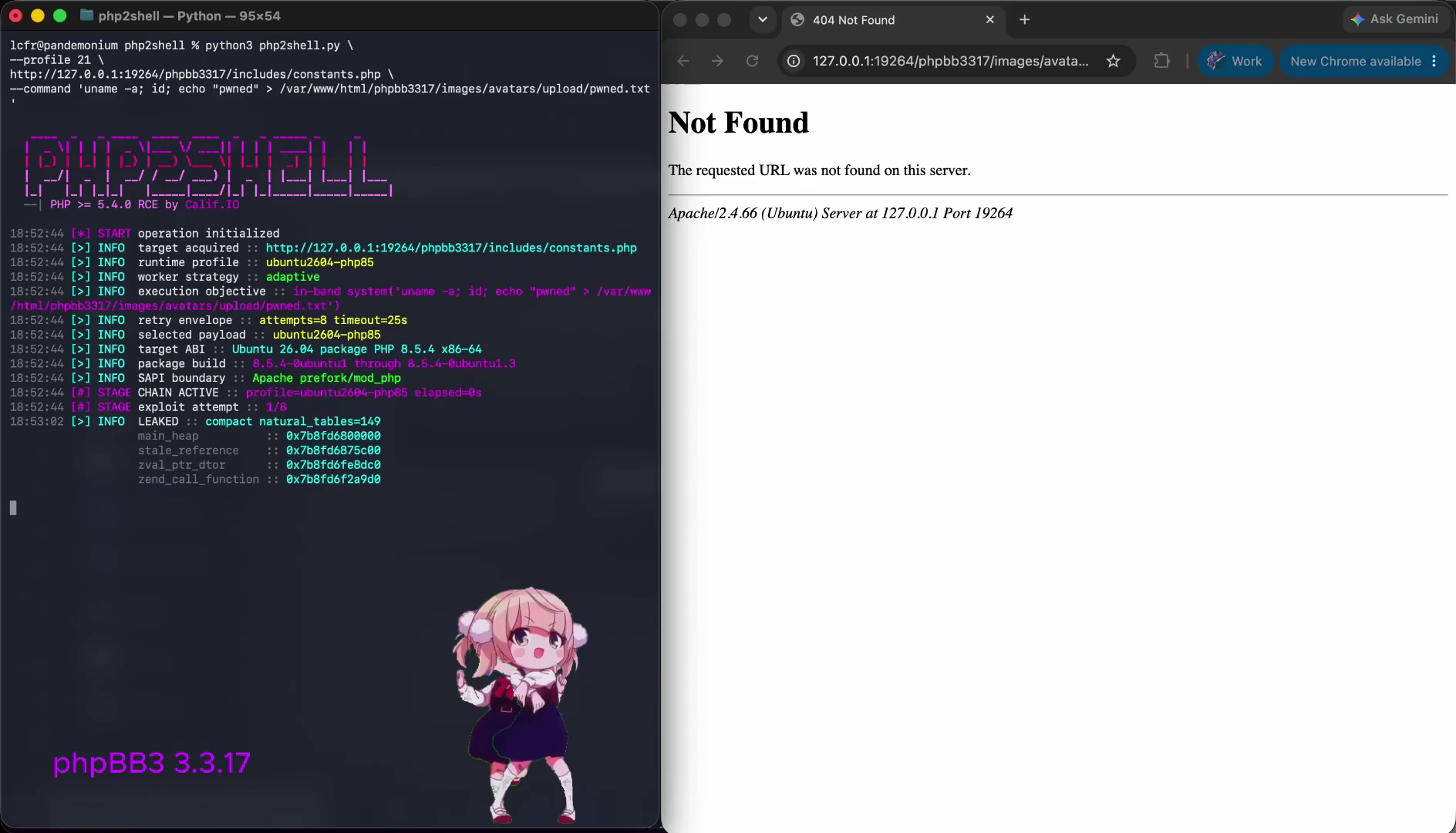
Technical analysis of the leaked demonstration video reveals the automated weaponization workflow of the php2shell tool.
The exploit is packaged as a modular Python weaponization framework (php2shell.py) designed to automatically profile the target environment, defeat modern memory protections like ASLR (Address Space Layout Randomization), and drop an in-band shell.
The Attack Execution Chain:
[1] Target Profiling ────► [2] Info Leak / ASLR Defeat ────► [3] Heap / Memory Corruption ────► [4] In-Band RCE
    Detects OS ABI             Leaks "natural_tables"              Corrupts SAPI Context             system('uname -a...')
    & PHP Build                (e.g., 0x7b8fd68e0000)              & Execution Registers             Drops 'pwned.txt'
Let’s look at the actual output logged during the exploit execution from the leaked tool:
[*] START operation initialized
[>] INFO target acquired :: http://127.0.0.1:19264/phpbb3317/includes/constants.php
[>] INFO runtime profile :: ubuntu2604-php85
[>] INFO worker strategy :: adaptive
[>] INFO execution objective :: in-band system('uname -a; id; echo "pwned" > /var/www/html/.../pwned.txt')
[>] INFO retry envelope :: attempts=8 timeout=25s
[>] INFO selected payload :: ubuntu2604-php85
[>] INFO target ABI :: Ubuntu 26.04 package PHP 8.5.4 x86-64
[>] INFO package build :: 8.5.4-0ubuntu1 through 8.5.4-0ubuntu1.3
[>] INFO SAPI boundary :: Apache prefork/mod_php
[#] STAGE CHAIN ACTIVE :: profile=ubuntu2604-php85 elapsed=0s
[*] STAGE exploit attempt :: 1/8
[>] INFO LEAKED :: compact natural_tables=149
    0x7b8fd68e0000
    0x7b8fd6875c00
    0x7b8fdef05dc0
    0x7b8fd6f2a9de
[+] SUCCESS :: Remote code execution verified (HTTP 200 / pwned.txt created)
Key Technical Observations from the Exploit:
- Target ABI Fingerprinting: The exploit contains pre-compiled offset profiles for major distributions (such as
ubuntu2604-php85, Debian releases, and RHEL builds). It matches the precise binary compilation offsets (8.5.4-0ubuntu1through8.5.4-0ubuntu1.3). - Two-Stage Memory Leak: Notice the
INFO LEAKED :: compact natural_tables=149stage. The exploit triggers an information disclosure in PHP’s internal data structures to extract live pointer values (0x7b8fd68e0000). This completely bypasses ASLR without causing a segmentation fault that would restart the worker process. - In-Band SAPI Hijack: Once the memory layout is known, the payload overwrites execution pointers inside the SAPI handler, redirecting execution directly into standard C
system()routines. The attacker executes commands under the web server’s identity (www-data,apache, ornginx).
4. The Affected Application Matrix
The leaked demonstration verified reliable, deterministic exploitation against the following widely used platforms:
| Target Platform | Vulnerable Endpoint Profiled | Impact |
|---|---|---|
| WordPress 7.x / 6.x | /wp-includes/registration.php, /index.php | Remote Shell / Database Hijack |
| Laravel 13.x & 8.x | /public/index.php | Full App & .env Exfiltration |
| Magento 2.4.9 | /pub/errors/processor.php | Card Skimmer / Payment Database Compromise |
| WHMCS Billing | /index.php | Hosting Infrastructure & Customer Takeover |
| phpBB 3.3.17 | /includes/constants.php | Server Takeover |
| Joomla 6.2.0 | /includes/defines.php | Core File Tampering & Persistence |
| MediaWiki 1.46.2 | /includes/Setup.php | Database Credential Theft |
| Symfony Demo | /public/index.php | Arbitrary Code Execution |
Notice the critical pattern: the exploit succeeds regardless of the application framework.
Whether it is an e-commerce giant running Magento, a SaaS company running Laravel, or a shared hosting provider using WHMCS, every application that invokes an affected PHP core runtime is vulnerable.
5. How to Check if Your Servers Are Under Attack
Threat actors are already scanning global IP ranges using the leaked tool logic. To identify if your servers are currently being targeted or compromised, run the following forensic checks.
A. Audit Web Server Access Logs for Probe Signatures
Look for rapid-fire requests targeting framework bootstrap scripts or internal files that standard users never call directly:
# Search for suspicious calls to static internal framework files
grep -E '(constants\.php|processor\.php|Setup\.php|defines\.php|registration\.php)' \
  /var/log/nginx/*access.log /var/log/apache2/*access.log 2>/dev/null
B. Inspect Web Server Process Trees
Look for child processes spawned by your web server or PHP-FPM workers executing standard shell binaries:
# Check if www-data or apache has spawned sh, bash, curl, or python
ps auxf | grep -E '(www-data|apache|nobody|nginx)' | grep -E '(sh|bash|curl|wget|python|nc|perl)'
C. Check for Dropped Artifacts
The default test payloads drop indicator files such as pwned.txt or randomize hidden .php web shells in web-writable directories:
# Search for recent files created in uploads, media, or avatar folders
find /var/www/ -type f \( -name "pwned.txt" -o -name "*.php" \) -mtime -3 -ls
6. The 5-Step Emergency Remediation Playbook
Until upstream patches are completely rolled out across all Linux repository mirrors, you must take proactive defensive measures immediately.
flowchart TD
    A["Emergency Remediation Playbook"] --> B["1. Update PHP Runtime Packages"]
    A --> C["2. Apply Virtual Patching at WAF Layer"]
    A --> D["3. Harden php.ini disable_functions"]
    A --> E["4. Restrict Admin & Billing Portals (Zero Trust)"]
    A --> F["5. Enforce Process & Container Isolation"]

    B --> G["Apt / Dnf Core Binary Updates"]
    C --> H["Cloudflare WAF / ModSecurity Blocking"]
    D --> I["Block system, exec, passthru, shell_exec"]
    E --> J["Isolate WHMCS, cPanel, Admin behind VPN"]
    F --> K["Read-Only Root Filesystems & Namespaces"]
Step 1: Update PHP Packages Immediately
Check for available updates from your distribution maintainers:
For Ubuntu / Debian:
sudo apt update
sudo apt --only-upgrade install php*-common php*-cli php*-fpm libapache2-mod-php*
sudo systemctl restart php*-fpm
sudo systemctl restart nginx # or apache2
For RHEL / AlmaLinux / Rocky Linux:
sudo dnf check-update | grep php
sudo dnf update php*
sudo systemctl restart php-fpm
sudo systemctl restart httpd
Step 2: Virtual Patching with WAF Rules
If an official distribution patch is not yet available for your specific legacy PHP version, deploy virtual patch rules at your Web Application Firewall (Cloudflare, AWS WAF, ModSecurity, or OpenLiteSpeed):
- Block Direct Requests to Internal Includes: Deny external HTTP requests attempting to invoke PHP files inside internal directories:
- Block requests matching:
*/includes/*.php,*/pub/errors/*.php,*/vendor/*.php.
- Block requests matching:
- Cloudflare WAF Custom Rule:
Action: Block(http.request.uri.path contains "/includes/" and http.request.uri.path endswith ".php") or (http.request.uri.path contains "/pub/errors/" and http.request.uri.path endswith ".php")
Step 3: Harden php.ini (disable_functions)
Prevent arbitrary command execution even if memory corruption occurs by disabling OS execution functions inside your production php.ini:
Edit your active php.ini (e.g., /etc/php/8.x/fpm/php.ini):
disable_functions = exec,passthru,shell_exec,system,proc_open,popen,curl_exec,curl_multi_exec,parse_ini_file,show_source,dlAfter modifying, restart your PHP service:
sudo systemctl restart php*-fpmWarning: Test your application in staging first if your software requires legitimate command execution (e.g., image manipulation tools like ImageMagick/Ghostscript).
Step 4: Isolate Administrative Portals (WHMCS & Dashboards)
If you run sensitive platforms like WHMCS, internal billing software, or administrative tools:
- Do not leave them exposed to the public internet on standard ports.
- Place them behind Cloudflare Access / Zero Trust tunnels or strict IP whitelisting.
- Even if an attacker has the
php2shellexploit, they cannot reach the endpoint to trigger the memory corruption.
Step 5: Containerize & Use Read-Only Mounts
Long-term immunity against core binary exploits requires architectural defense in depth:
- Run PHP applications inside Docker/Kubernetes containers with read-only root filesystems (
readOnlyRootFilesystem: true). - Mount only specific media upload folders with
noexecflags so dropped binaries or web shells cannot execute.
Summary & Next Steps
The #PHP2Shell disclosure and Silas Cutler’s telemetry are a stark reminder: security is only as strong as your lowest infrastructure layer.
Relying solely on CMS security plugins will not protect your servers when the underlying language interpreter is compromised.
If you suspect your servers have been targeted, or if you need expert infrastructure engineers to audit, patch, and harden your cloud fleet, reach out to the KloudBoy Security Team. We provide 24/7 emergency incident response, zero-downtime kernel patching, and high-performance sovereign cloud hosting.
Stay safe, patch immediately, and monitor your server logs.
Website hacked or dealing with malware?
Our 24/7 security engineers clean malware, harden servers, and restore uptime in under 2 hours.
Get Emergency Security Help